Sustainable and Ethical Sourcing for Jewelry Makers
Sustainable handmade jewelry materials are the ones that are reused, recycled, renewable or responsibly sourced, and that hold up to wear. Start with reclaimed and recycled metals and glass, add wood, shell or plant-based pieces for warmth, then check durability, care needs and supplier traceability before you commit to a batch.
Four criteria decide whether a material earns a place in your supply drawer: a renewable, upcycled or responsibly sourced origin; the avoidance of harmful mining; durability in the finished piece; and support for small-scale artisans rather than mass production. Each can be checked before you buy. Ask where the material came from and whether that source is documented, ask what mining or processing it involved, test how it holds up in the finished piece, and ask who made it and under what conditions. Recycled silver from a large industrial refiner may be beyond reproach on origin and still tell you nothing about who handled it.
Sustainability is a lifecycle question, not a label on a bag. A beautiful fiber or stone that pills, chips or tarnishes within a season fails the test, because the maker's time, the packaging and the shipping all get thrown away with it. Before you fall for a surface, ask how the piece will look after a year of daily wear and what care it demands.
Put the questions to suppliers in writing: where the material comes from, how much recycled content it contains, and under what conditions the workshop operates. Vague "eco" or "green" wording is an unanswered question, not a credential. Certification schemes such as Fairmined for gold and the Kimberley Process for diamonds are starting points rather than a full audit, so treat a certificate as one piece of evidence among several.
None of this requires a perfect material. It requires a maker who knows what each choice can prove and designs accordingly.
Recycled and reclaimed glass: color with a past
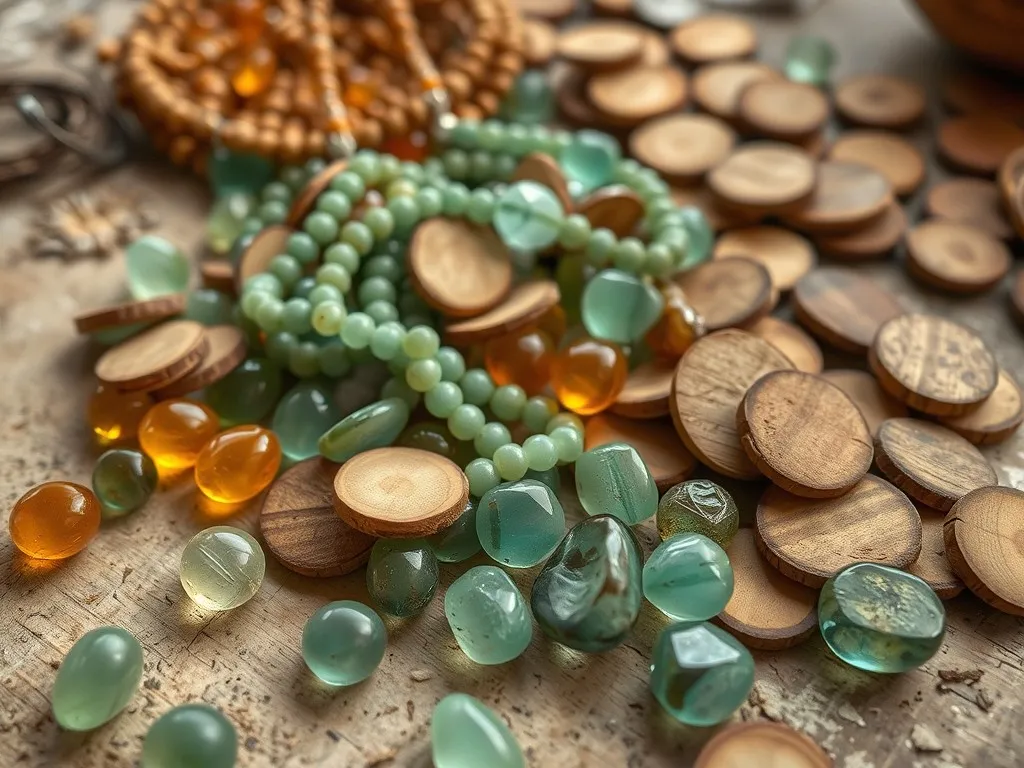
Glass that has already lived a life behaves differently from precision glass, and that is the point. Recycled glass beads from Ghana and Indonesia are made from repurposed glass, and they often show cloudy translucency, matte areas, gentle pitting, layered color and imperfect shapes. Those traits come from the source material rather than a flaw in the process, so plan a design that can absorb them. If you want the full picture of how a material's past shapes a finished piece, these popular handmade jewelry styles show how widely makers interpret that idea.
Sizing is where recycled glass asks for care. Hole size, shape and finish vary more than precision glass, so measure your stringing material against the actual holes in a batch before you commit to a cord or wire, and match your beading needles to the hole rather than assuming a standard gauge will pass. Irregular shapes also change how a strand hangs, so lay beads out in sequence before stringing and expect to reorder them.
Czech glass offers a different kind of sustainability: durability. It is described as durable and endlessly reusable and comes in a wide range of finishes and shapes, including fire-polished rondelles and pressed glass leaves, which makes it a strong base for pieces meant to be restyled rather than replaced. Pair it with reclaimed glass where you want color with a history, and let the Czech components carry the structural work.
Photograph the variation honestly. Shoot a close detail of the cloudy patches, the layered color and the irregular silhouette, and say in the listing that each bead differs. Buyers who see the texture before purchase read it as character; buyers who discover it on arrival read it as a defect.
Wood, coconut shell and other warm naturals
Wood and coconut shell bring warmth that metal and glass cannot match, but they behave like what they are: absorbent plant material. They take on moisture, and they react differently to oils, perfumes and long hours in direct sun. That makes them a natural fit for necklaces and earrings, which sit away from soap and water, and a poor fit for rings, bracelets or anything that meets a sink several times a day.
Holes matter as much as the surface. A rough or irregular hole grinds against cord every time the piece moves, and the cord fails long before the bead does. Choose a larger cord, add a knot between beads to spread the wear, or line the hole with a wire guard. Check each hole by running a fingernail around the inner edge; if it catches, treat it before stringing.
Plant-based resins and responsibly sourced bone or shell can round out a collection, provided the supplier documents where the material came from. Ask for that origin in writing, the same way you would for salvaged parts in functional rings. Undocumented material is a claim, not a source.
Natural pieces age visibly, and buyers need to expect that before they pay. State the care instructions plainly in the listing: keep the piece away from perfume and water, wipe it dry, store it out of direct sun. A buyer who knows the wood will darken reads the change as patina rather than damage.
Reclaimed, vintage and leftover components
Before an old component goes into a new design, handle it the way you would handle a customer return. Bend the loops gently to see if the metal work-hardens and snaps, run a fingernail along the coating for chips, and check the finish for flaking at the edges where it wears first. Thread and cord deserve the same suspicion: pull a short length between both hands, and if it feels stiff or sheds fibres, it has aged out of service. A salvaged piece that fails these tests is still worth keeping for its beads or clasp, but it should not carry the weight of a finished design.
Recycled brass is the most practical reclaimed metal for a small studio. Artisan workshops collect scrap brass and repurpose it, which keeps the metal in circulation and avoids the demand for newly mined ore. Ask a supplier how the scrap is collected and whether the alloy is consistent between batches, because recycled brass varies in colour and hardness.
The quickest low-impact piece is often a salvaged chain with a new pendant. The chain already exists, so the only new material is the focal element, and the piece carries a visible history that buyers respond to. If you are unsure how to tell a genuinely old chain from a modern imitation, spotting authentic handcrafted details is worth learning before you describe a piece as vintage.
Keep a short written log for every reclaimed part: where it came from, roughly when, and what condition it arrived in. A line per batch is enough, and it lets you answer buyer questions about origin without guessing.
A five-question checklist before you buy a batch
Before you commit to a batch, put five questions to the supplier in writing. The answers are your paper trail, and a supplier who cannot answer them plainly is telling you something useful.
First, ask where the material comes from, what share is recycled or reclaimed, and who made it. A vague answer about a region is not the same as a named workshop or collector. Second, ask how the supplier verifies conditions in that workshop and whether any certification applies to the material or the process. Certification is not the only proof, but it should be specific rather than decorative.
Third, request a sample and work it before ordering volume, because a photograph will not show you how glass edges soften or how a wood grain lifts.
Fourth, ask what happens to offcuts and packaging, and whether they return to the supplier, get reused or go to waste. Fifth, decide whether those answers are good enough for your brand before you pay, not after the box arrives.
Design so there are fewer leftovers
Waste is decided at the bench as much as at the supplier. Before cutting a sheet or ordering beads, sketch the piece around the lengths your materials actually come in, so offcuts stay large enough to become earrings, bails or inlay rather than dust. A maker who plans the cut sequence can often fit two small components into space that would otherwise be trimmed away and swept up.
Design for repair from the start. Choose findings, clasps and stringing you can open, replace and rethread, instead of sealed construction that turns a broken clasp into a discarded piece. A customer who can bring a necklace back for new cord keeps wearing it, and the metal stays in circulation.
Build small capsule collections that share components. If several designs use the same bead size, chain gauge or stone shape, surplus from one piece feeds the next, and a short run of an unusual colour stops being dead stock. Fewer distinct parts also mean fewer partial batches left on the shelf.
Keep a scrap jar sorted by material, with metal, glass, wood and cord in separate containers. Treat what accumulates as a design constraint: when a jar fills, make something from it. Leftovers then shape the next collection instead of sitting in a drawer until they are thrown out.
Frequently Asked Questions
Is recycled glass jewelry as durable as new glass?
Recycled glass jewelry can be durable, but it varies more than precision glass in hole size, shape and finish, so expect gentle pitting and imperfect shapes as part of its character. Measure your stringing material and use beading needles matched to the hole size, and treat rough holes with a larger cord, knotting or a wire guard to limit abrasion.
How do I verify that a supplier's recycled metal claim is real?
Ask the supplier for documentation tracing where the metal was collected and how it was repurposed, rather than accepting the word recycled on a label. Reputable workshops can explain their collection and refining steps, and a supplier who cannot describe the source chain in specific terms is worth passing over.
Can wood and shell jewelry be worn every day?
Wood and coconut shell can be worn often, but they absorb moisture and react differently to oils, perfumes and prolonged sun, so they suit necklaces and earrings better than pieces that face constant handwashing. Keep them away from water and fragrance where possible, and store them dry to slow wear.
What should I ask an artisan workshop before placing a wholesale order?
Ask how materials are sourced, who makes the pieces and under what conditions, and how consistent the finish will be across a batch. Request samples to check hole sizes and coatings, confirm lead times and reorder terms, and ask what happens when a component is unavailable.
For the full overview, see ethically made jewelry resources.
Related in this series: authentic handmade jewelry identification, types of handmade jewelry styles.